Better questions before more data
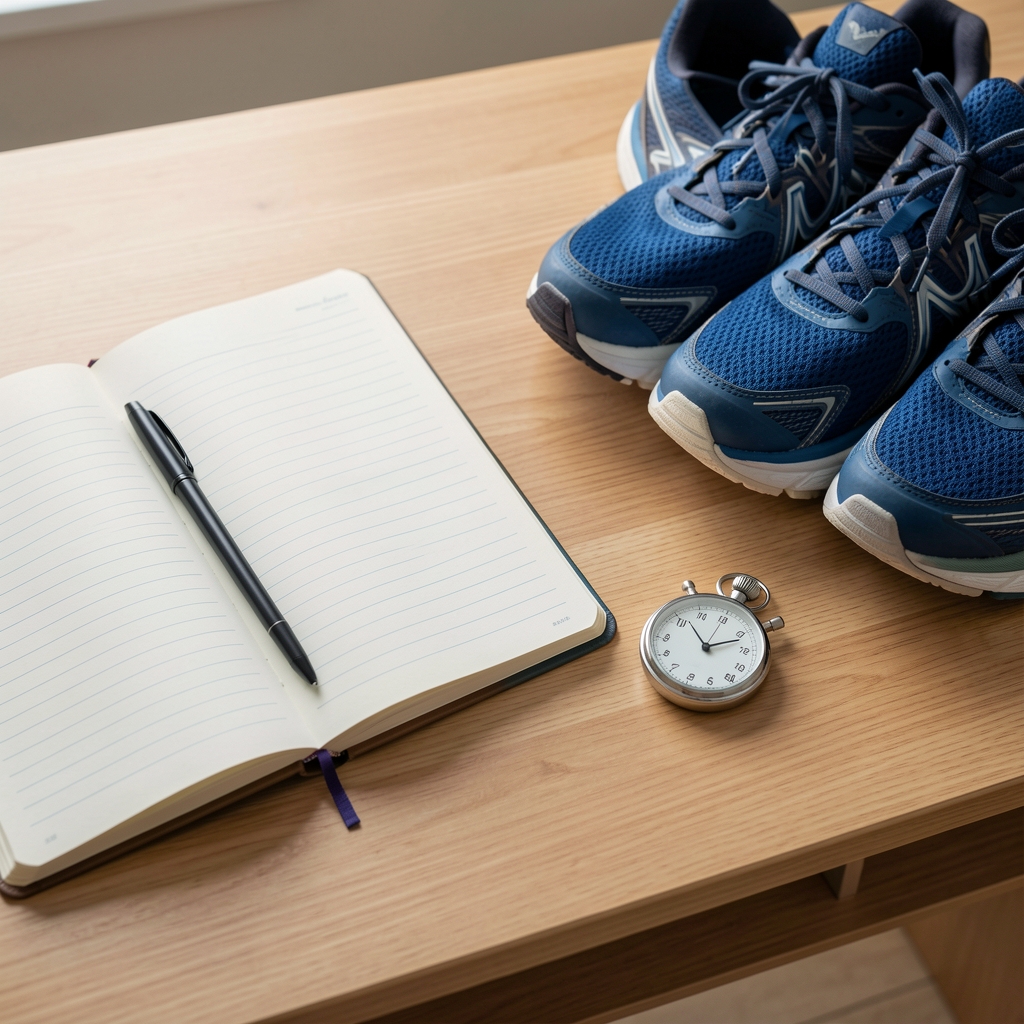
Assessment can help organise an observation, but no single test describes the whole person. Perma explores how to combine purpose, setting, repeatability, and interpretation when considering cardiovascular stamina or functional movement.
The emphasis is on clarity. A measurement is useful when the reader understands what it represents, what it leaves out, and how conditions may influence the result.
The assessment lens
| Question | Why it matters | Example record |
|---|---|---|
| What is the purpose? | Different goals require different observations | Steady walking, strength control, or routine planning |
| What is the setting? | Heat, terrain, equipment, and time can alter a session | Indoor room, humid park, or travel day |
| Can it be repeated? | One unusual day has limited context | Same task on several ordinary days |
| What remains unknown? | Limits prevent overinterpretation | Personal history and individual circumstances |
Building a useful observation
- Write the question in one sentence.
- Choose a simple, familiar task connected to that question.
- Record the setting, duration, and perceived effort.
- Repeat only when the surrounding conditions are reasonably comparable.
- Review the pattern without treating it as a complete personal assessment.
- Use the same terms each time.
- Note interruptions or unusual conditions.
- Avoid comparing unrelated tasks as though they measured the same capacity.
Interpretation needs restraint
A result can prompt a better question without supplying the final answer. If a recurring concern, major change, or personal history affects the decision, individual guidance is a more appropriate next step than relying on a general resource.
“A measurement becomes useful when its limits are visible.”
Assessment questions
Does Perma offer personal testing?
The site provides editorial frameworks and information. Any individual evaluation should be discussed with an appropriately qualified local professional.
How many metrics should I track?
Begin with the smallest number that answers the question. More data can add noise when its purpose is unclear.
Why record the environment?
Weather, terrain, room temperature, clothing, equipment, and schedule can influence how a familiar task feels.
Questions around a result
The most interesting part of an assessment is often not the number itself but the conditions around it. Was the task familiar? Was the person rested? Was the environment different? Did the purpose of the session change? These questions help prevent a result from being treated as a complete description of capacity.
Assessment can also be affected by how a task is introduced. A rushed explanation, an unfamiliar device, or a distracting setting may change the observation. Recording these details does not invalidate the result; it helps explain what the result can and cannot support.
- State whether the task was familiar.
- Record the basic environment and timing.
- Use the same terms when comparing observations.
- Do not infer a diagnosis from a general educational framework.
Assessment record template
| Field | Example entry | Reason to include it |
|---|---|---|
| Date and time | Morning, weekday, local time | Allows later comparison |
| Task purpose | Observe steady walking pace | Defines what the record is about |
| Setting | Shaded route, humid conditions | Shows environmental context |
| Perception | Comfortable, interrupted twice | Preserves the lived observation |
| Limit | No comparison to other tasks | Prevents a broader conclusion |
A simple record is often easier to maintain than a detailed one that becomes another source of pressure. The point is to support a clearer conversation with oneself or an appropriate professional, not to create a public score.